

Throughout the long history of the greatest country in world history, the United States of
America has been at war almost constantly. In fact, from the nation’s founding until 1890, the
United States was in nearly constant war against the various Indian tribes resisting its
expansion and Manifest Destiny. One of the most significant battles fought in the long Indian
Wars was the Battle of Tippecanoe.
In 1811, America was a much different country. There were only 17 states, the
westernmost being Tennessee. James Madison was the President, and William Henry Harrison
was the most important officer in the U.S. Army. The most significant threat to national securitywas not foreign powers or the Napoleonic Wars raging in Europe, but the Shawnee tribe in Indiana, who were waging Tecumseh’s War against the U.S. Army.
Tecumseh himself was the chief of the Shawnee. One of the most famous Indians in
history, he was in command of a coalition of tribes trying to resist U.S. expansion into Indiana.
Tecumseh’s brother, Tenskwatawa, known as “The Prophet,” was a spiritual leader for the
Indians and had helped expand Tecumseh’s Confederacy. At the time of battle, Tenskwatawa
was actually in command, as Tecumseh was away recruiting more warriors. This would prove to be a major loss for the Indians, as Tecumseh was an excellent military commander, and
Tenskwatawa would prove no match for William Henry Harrison.
On November 6, 1811, Harrison’s army arrived at Prophetstown, the encampment of the
Indians along the Tippecanoe River. The vanguard, under the command of`Lieutenant Colonel
Joseph Bartholomew, nicknamed “Black Bart,” found he was nearly encircled by the Indians
amid the darkness at 4.30 hours. The U.S. forces mostly consisted of militiamen, whose small
caliber rifles had little effect on the charging warriors.
At this critical juncture, with the infantry in trouble, the great military commander of the
age, William Henry Harrison, stood with a big choice – order a retreat or press the attack.
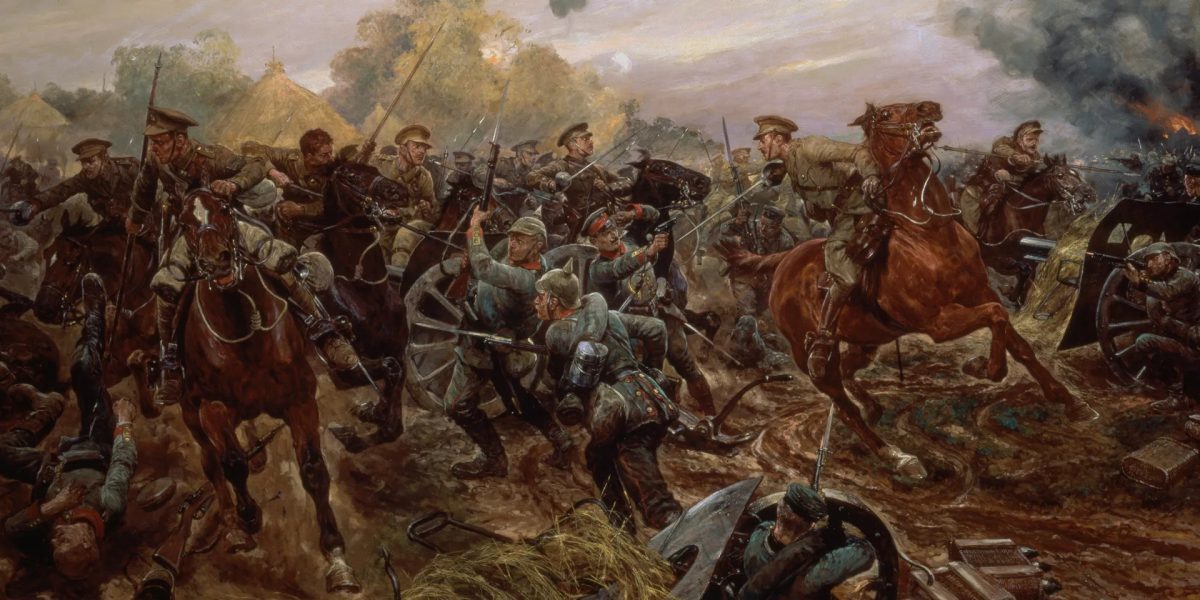
Harrison, uttering words that would be remembered for all history, gave the order “Dragoons
forward!” These regular Army soldiers, armed with powerful weapons on top of horses, and
some dismounted, were able to clear the grove filled with Indians to the front, but attacks were
still coming to the rear. Bearing the brunt of these was a regiment that would be famous for all
time – The Indiana Yellow Jackets, militiamen recruited from neighboring counties, were baring down the brunt of the Indian attacks. With fearless courage and nerves of steel, they stood firm, but took horrible casualties. All but one officer was killed, refusing to abandon their men to the fury of the Indians and realizing the inevitable disaster of retreat. If the Yellow Jackets broke, all of Harrison’s army would be completely annihilated.
Through superhuman will, John Tipton, the last officer in the Yellow Jackets, kept the line
and kept the line. Finally getting a break on the front line, two reserve regiments were sent up,
enough to keep the line. For another hour, all of the regiments held off several charges. After
about two hours, the sun was finally rising. In the golden sun, which seemed to be as
unsurmountable as Manifest Destiny, Harrison realized that the Indians were actually much
weaker than he had assumed. A general charge was ordered, and the Indians were sent into a
hasty retreat to Prophetstown, where they blamed Tenskwatawa for the defeat and fled.
Prophetstown was abandoned, the war ended, and Indiana opened for American settlement.
Harrison himself filed a report, reporting the casualties as follows: “KILLED — One
Aid-de-camp, one Captain, two Subalterns, one Sergeant, two Corporals, thirty Privates.
WOUNDED — since dead — One Major, two Captains, twenty two Privates. WOUNDED — Two Lieut. Colonels, one Adjutant, one Surgeon’s Mate, two Captains, three Subalterns, nine
Sergeants, five Corporals, one Musician, one hundred and two Privates. Total of killed and
wounded — 188. ” This was an astonishingly low figure for a near defeat in a major battle.
Indian losses were more than twice as high, besides the obvious loss of territory. While
Tecumseh lived, and would continue to command his tribes until his death to Harrison at the
Battle of the Thames in 1813, Harrison became the Governor of Indiana, a General in the War
of 1812, remembered as one of the ablest commanders in our country’s histories, and finally the 9th President of the United States from March 4, 1841 to April 4, 1841 – the shortest presidency, though he delivered the longest inaugural speech. He was elected on the slogan “Tippecanoe and Tyler Too” a reference to his nickname after the great victory.
For all of us here budding military commanders at Cardinal Newman, William Henry
Harrison teaches us important lessons. First, it is important to have nerves of steel. Harrison
never became unfazed and continued to press the attack amid chaos and seeming defeat.
Second, it is important to have solid soldiers and officers who will not falter under pressure, will seize initiative, and never admit defeat, like John Tipton and the Yellow Jackets showed us. Lastly, it is important to always keep in mind that defeat is never inevitable. Had Harrison
ordered a retreat, he would never have realized that the Indians were so weak, and would not
have won this great battle. As the later but just as great commander General George S. Patton
said, “You only lose once you’ve admitted it. Hence don’t.”